
ONLINE COURSE
Fertility awareness
Learn to recognise your fertility signs, chart your menstrual cycle and make sense of the patterns you see.

Benefits of fertility awareness
Charting your cycle can help you spot changes and give you something concrete to discuss with your partner or a healthcare professional. If you use fertility awareness for family planning, its effectiveness depends on the method you choose and how consistently you follow it.
Fertility awareness methods
Fertility awareness is a way to understand your menstrual cycle and use that knowledge for natural family planning. With the symptothermal method, you chart your basal body temperature and changes in cervical mucus. An instructor can help you interpret your chart if your cycles are irregular, you’ve recently given birth or you’re breastfeeding.
Who is this course for?
- Girls and women who want to understand their cycles, whether regular or irregular.
- Anyone who wants to track changes in their cycle and discuss them with a clinician.
- People preparing for married life.
- Couples planning a pregnancy, including those who have had difficulty conceiving.
- Couples who want to delay pregnancy and learn to use their chosen method consistently.
- Couples exploring non-hormonal family planning options.
- Women who would like help charting their cycles after childbirth or while breastfeeding.
- Mothers who want to help their daughters understand the menstrual cycle.
- Women who want to pay closer attention to changes in their reproductive health.
What you’ll learn
- Recognise your fertility signs and understand how they change over the course of your cycle.
- Identify the likely fertile window using the rules of the symptothermal method.
- Use your chart when trying to conceive and discuss the rules for delaying pregnancy with an instructor.
- Keep a cycle chart and discuss with your clinician how it might help them estimate how far along a pregnancy is.
1Lesson
- The history of fertility awareness
- The male reproductive system
- How the male reproductive system works
2Lesson
- The female reproductive system
- How the female reproductive system works
- Primary signs of fertility
3Lesson
- Additional signs of fertility
- The key rules and concepts of the symptothermal method
- Identifying likely fertile and infertile phases in the menstrual cycle
4Lesson
- Charting when trying to conceive
- Atypical cycles
- The return of fertility after childbirth
5Lesson
- Fertility before menopause
- Contraception
- The return of fertility after stopping contraception
6Lesson
- Reproductive technologies
- Abortion
- Benefits of fertility awareness
Bonus lectures
- Maternal and infant health during pregnancy, with Vira Trynka, obstetrician and gynaecologist.
- Natural childbirth
- The placenta in traditional chakra beliefs
How I discovered fertility awareness
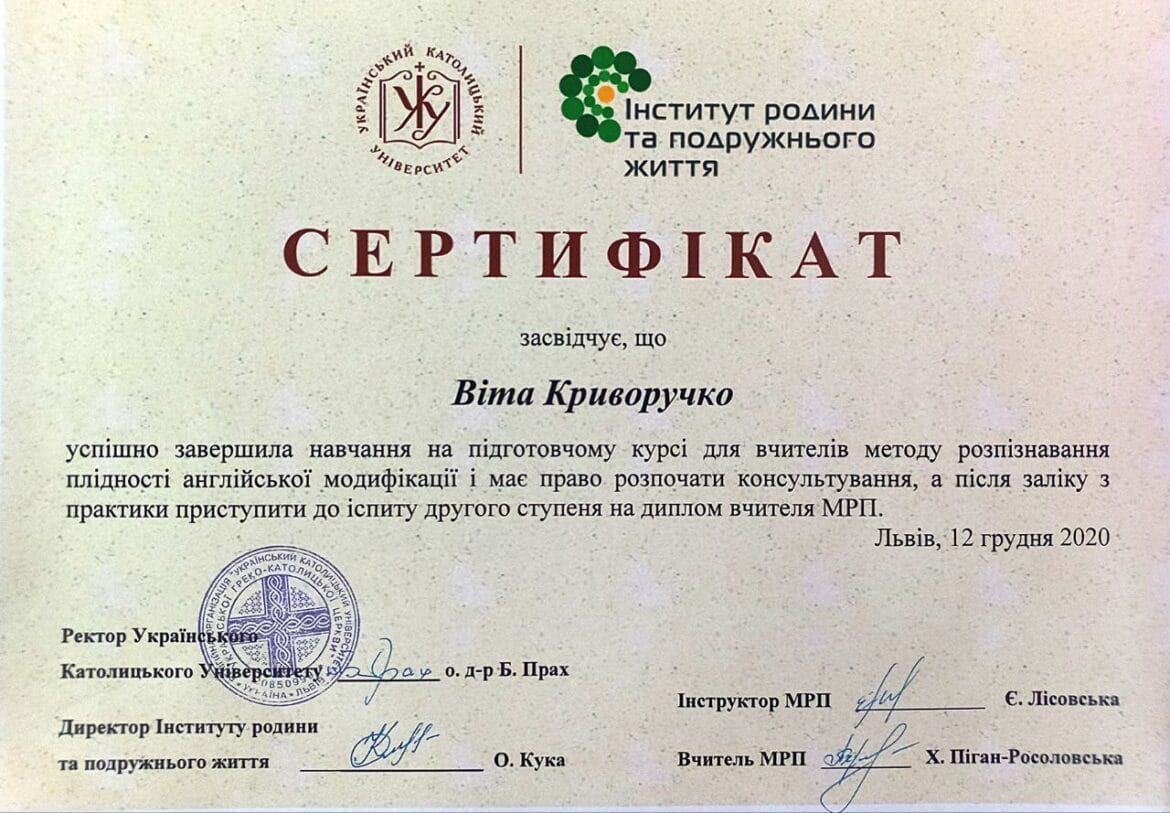
I first heard about fertility awareness on a retreat before my wedding in 2011. It was at the Ukrainian Greek Catholic Church of the Transfiguration in Horodok, in the Lviv region. I started charting straight away. My husband and I had agreed to wait five years after our wedding before trying for a baby.
I read a book by Olesia Kuka, Zoreslava Horodenchuk and Olha Sokalska called Learning to Recognise Fertility, which I still recommend. Svichado published the third edition in 2024. It is for readers who already practise fertility awareness and anyone who wants to learn with an instructor.
I’m grateful for what I learnt, especially when we started trying for a baby in 2015. Six months went by without me getting pregnant. My husband often travelled abroad for chess tournaments and was away on days when my chart suggested I was fertile.
As women, we spend much of our lives trying to keep pace with a world that never stops. We expect ourselves to be just as productive every day of the year, ignoring tiredness, hormonal changes and what our bodies are telling us.
I’ve been there. I know what burnout feels like when you try to push through just as your body is asking for rest. Things changed for me when I started to understand my body better.
What fertility awareness gave me
Fertility awareness helped me make sense of my cycle signs. For me it meant less guesswork, a better understanding of what was changing, and permission to live at my own pace.
Health, work and money
I believe success and respect for our own rhythm go hand in hand. Work, money and ambition feel different when you have the energy for them. In my work I bring observations about the menstrual cycle into a wider conversation about financial independence.
Keeping a record helps me notice patterns, make room for rest and approach financial decisions more thoughtfully.
Why I share what I’ve learned
I went from feeling overwhelmed to understanding my own rhythms. My projects are for women who want to take more ownership of their lives. I built VitaApp for recording observations, and I write books and build a community where women can learn at their own pace.
Let’s grow together
If you’re ready to stop fighting your body and start paying attention to its signs, begin by observing them. My cycle has become a compass for me.

Spend a minute each morning charting with VitaApp
Keep your observations together on your phone so you can look back at them whenever you like.
VitaApp is currently in development.
Open Google PlayWe’ll explore the symptothermal method in more detail on the course.
An instructor will support you as you practise charting three to four cycles and learn to read your charts independently. Sharing what you notice can make it easier to talk about family planning.
This programme is grounded in respect for human life from the moment of conception.
Frequently asked questions
How does fertility awareness work?
In the symptothermal method, you record your morning basal body temperature and observe changes in cervical mucus every day. These signs help identify likely fertile days.
How is this different from the calendar method?
The calendar method uses the lengths of previous cycles. The symptothermal method uses signs from your current cycle. These signs can be harder to interpret with irregular cycles, so it helps to learn the rules with a qualified instructor.
What are fertility awareness methods used for?
They can help you understand your cycle and identify the likely fertile window when planning a pregnancy. If you want to avoid pregnancy, follow the rules of your chosen method, including abstaining or using a barrier on fertile days. Effectiveness varies by method and how it is used.
Why does the symptothermal method use more than one sign?
You look at changes in cervical mucus alongside your basal body temperature, following the rules of the method. Looking at both gives you more context if poor sleep, illness or medication affects one of the signs.
Can ovulation tests replace fertility awareness?
Ovulation tests detect a rise in luteinising hormone (LH), which usually happens before ovulation. A positive test does not by itself confirm that ovulation has occurred or tell you when the fertile window started.
Do I have to wake up at the same time every day?
Take your basal temperature after waking and before getting out of bed, ideally at the same time. Note changes in timing, poor sleep or illness. Interpret your measurements using the rules taught by your instructor.
What if my cycles are very long or irregular?
Keep recording your signs daily. When the length of your cycle varies, calendar dates alone tell you little. If your cycles are often irregular or you suspect polycystic ovary syndrome (PCOS), discuss it with your gynaecologist.
Can a fertility chart be used to diagnose a condition?
You can share your chart with a gynaecologist or endocrinologist. It can give them useful context for deciding whether further assessment is needed.

Listen to yourself.
Start with an honest conversation with yourself. That’s where change begins.
Book a consultation